


What happens to journalism when AI agents need it, but readers no longer need to visit it?
That question followed me to Austin for ISOJ 26, where I joined Zach Seward from the NYT and Nathalie Malinarich from the BBC to explore how agentic AI could reshape news consumption, at Rosental Alves’s invitation.
We came at it from different angles, but kept circling the same problem: journalism may become increasingly useful to machines but lose provenance and the capability to convey trust.
Zach focused on the strange authority of the AI answer. When information from many sources gets compressed into one confident response, it can look more objective precisely because the seams have disappeared.
“Here comes along a technology that conveys trust through its design choices, flattening source material into an objective truth. And increasingly human, using human metaphors that lean on our natural instinct to trust people.”
Nathalie approached the same problem from the other end: what happens to trust when the journalism travels, but the publisher’s interface, brand and relationship with the audience don’t?
“Our journalism will be consumed by audiences who probably might not know it’s from us, might not know what the original story is, might not see the brand, know the context, or any of the editorial signals we wrap around content.”
Which touches on a very important aspect: you can signal much more value by structuring information for agents upstream than by feeding articles into an LLM to make it extract information.
I’ve written quite a bit here about going beyond the article and treating agents as customers. Now that we’re actually trying it, there’s a lot to unpack. So here are a few things I took away from the discussion, mixed with what we’re learning from building Mizal’s swarm of agents.
Trusted travelers
We’ve been experimenting with a team of agents focused on one “obsession”, as we call it: NVIDIA. The idea is to keep working on the same subject day after day, and see how far they can go. Can they find useful sources, spot something worth following up on, and keep track of what remains uncertain?
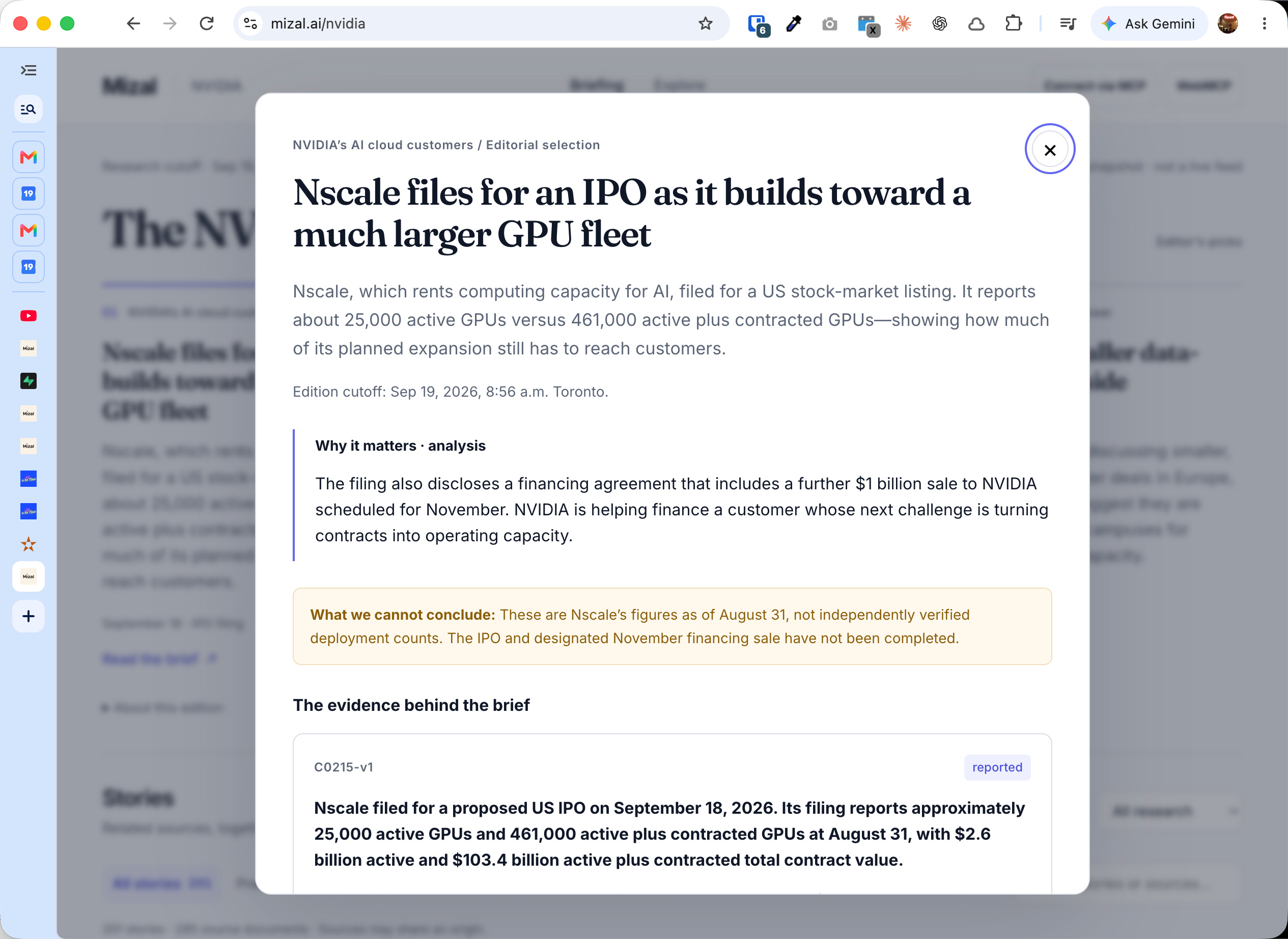
The playground opens on a briefing. Behind it, there’s a whole research process that breaks down into four layers:
Retrieve: Each agent has their own specialization, fetching material from company announcements and filings, independent reporting, technical publications, social media, podcasts, etc. They also look beyond the sources we already follow, using unanswered questions to guide the search. They record what they could actually read, so an inaccessible article stays a gap.
Evaluate: Then they evaluate the credibility of each source. Who originally made the claim? Is this a company describing its own product, a journalist reporting on it, or someone who tested it? Do several articles provide independent evidence, or are they all repeating the same announcement? We keep those distinctions attached to the claims. A company release can establish what a company announced, but it can’t on its own establish that the promised capacity is already operating.
Judge: We ask the agents to make an editorial judgment: what’s new here, why does it matter, and is it worth putting in the brief? Something potentially important may need more reporting before we can say much about it. This is the editorial judgment layer.
Trace: Each story in the brief connects to specific claims. Those claims connect to evidence records with source links, dates, passages or locations in the source, and an explanation of what the evidence supports. Counter-evidence and unresolved questions stay in the dossier too. A separate agent reviews the proposed claims before the briefing is assembled, though another agent checking the work doesn’t count as another independent source.
So when you read the brief, you can dig into why we’re saying something and where the evidence runs out. New findings can update a claim without erasing what we previously thought.
The reader can also be your agent. We expose everything through WebMCP and MCP so agents can access the briefing, its claims and their supporting material.
Along the way, we carefully observe what needs to be adjusted and teach it to the model, building a training dataset in the process.
This is only one side of the coin, the other being… making actual real coins.
A $2 test
In my keynote, I highlighted the disturbing paradox for journalism today: You can be essential to the answer and absent from the transaction.
Because before an agent can find the answer, someone has to find out. Attend the hearing or call the source who knows. Someone has to produce information that was not available before.
(Which raises the fundamental question of the amount of original information newsrooms are producing, as the rest will be heavily commoditized. And the depth of your connection with the readers)
But the problem is being useful to more people does not automatically pay for that work. There’s a whole gray market of commercial scraping services getting around some publisher controls and paywalls (Something we talked about extensively at Perugia with Shuwei Fang and Lucky Gunasekara).
In this context, publishers are playing defence - which is a sensible move in the context. But if we can’t ban Napster, how do we explore Spotify? Meaning, if there is demand, can we give it a legitimate way to pay?
The good news is payment architecture is maturing. What we saw with HTTP for the internet is being built for the agents today.
To show how it works concretely, I recently gave an agent a $5 test budget and a question: which NVIDIA infrastructure projects are actually operating, and which are still just announcements?
For the purchase experiment, I pointed my agent at our playground. It searched the free information, checked what a prepared comparison covered and looked at its research cutoff. Then it spent $2 in test money and came back with an answer, sources and a receipt. We can see the matching successful payment in Stripe’s test dashboard.
(Before you wonder if I’m creating a circular payment scheme, this is a sandbox with Monopoly money ;) )
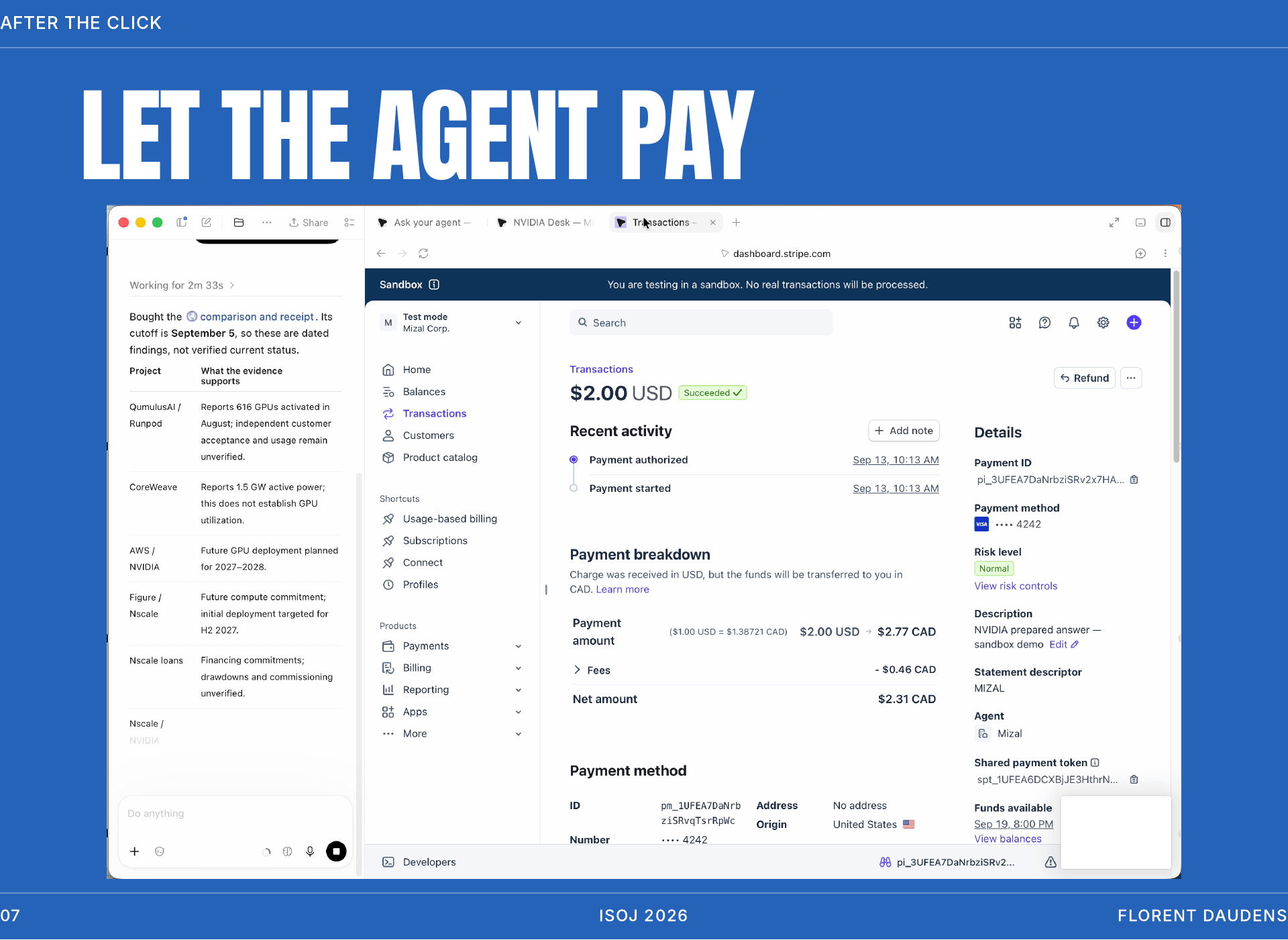
That’s one successful interaction with one prepared offer, on our own prototype. It doesn’t prove that agents are good information buyers at scale, but this is a very interesting early signal. It’s also fascinating to observe their reasoning traces in evaluating the value of information.
It does give us something concrete to examine. Now I want to know how consistently that happens, including when the question is less clear or the evidence conflicts.
Why a convincing answer is such a tricky thing
Zach described something that surprised him in his talk. In conversations with Times readers, some saw journalists as biased and AI summaries as more objective because they combined information from several sources.
I can understand the appeal. Something has seemingly read everything for you and brought it together. It feels like the checking has already happened.
Except several sources can repeat the same press release. They can disagree for good reasons that disappear in the summary. Or vary widely in relevance, from a top expert to a smart aleck.
This is where Nathalie’s question about how trust travels becomes very practical. Does the reader know whose reporting they’re using? Can they tell what the agent changed? If it gets something wrong, who will they blame?
For our NVIDIA experiment, that means looking beyond whether the agent found the relevant packet. I want to see whether it distinguishes a company’s announcement from independent evidence that a project is operating. Whether it keeps a disagreement visible. Whether a correction reaches the next answer. Which is why building agents that encode all of this upstream before interacting with user agents is crucial. Call it architecting trust.
While we write and while we read
We’re also working on this inside Mizal at the level of individual passages. Agents identify claims in a document and attach assessments to the exact text. A reviewer can challenge an assessment, add a missed claim or leave a note. The review stays connected to the statement being discussed.
During content creation, that gives us a way to question a draft before it goes out. Is this sentence stronger than the evidence? Does it turn a forecast into something that has already happened? In the NVIDIA workflow, the claims and evidence are already there when we build the brief. We can carry those references into the writing.
The same approach is useful during consumption. You can bring in an article, report or AI answer you’re trying to understand and examine its claims. That makes it possible to ask a specific question about a specific passage, with the assessment attached to it. The reader doesn’t have to accept or reject the whole document as one block.
Source review is a separate step, where the question becomes whether a passage supports the wording, only supports part of it, or contradicts it. Anything we haven’t checked needs to remain visible as unchecked.
What I’d like to carry from creation to consumption is that record: what was claimed, what was checked and what still needs an answer. A reader, an editor or another agent could then inspect the reasoning and challenge it.
An experiment published in Nature shows a similar concept for research. Paper2Agent turns research papers and supporting materials into resources and tools that agents can use. I’ve already written about making the evidence behind a story inspectable. What’s interesting here is that the reader can also put a method to work.
Imagine a newsroom spends months investigating access to public services. It publishes the story and makes a safe, documented version of the underlying analysis available. A reader could ask what the findings look like in their neighbourhood. Another newsroom could try the method with its own local data.
These are journalism possibilities I’m extrapolating from the research. But they highlight something even more crucial: newsrooms can’t produce only articles in this new ecosystem. Which connects to something Zach mentioned:
“I think we need to pretty dramatically change how we publish information in the first place, connect it to citations of supporting facts and allow our readers and agents to do their own research along the way.”
Your agent could bring your subscription
There are also ways to experiment without asking every reader to become a researcher. Axios is exploring a personal-agent feed as one of its proposed Axios Direct offerings. According to Digiday, that version is still at an early stage, with deeper exploration planned for 2027.
As a reader, I find the idea pretty straightforward: I pay for my subscription, and I’d like my assistant to have legitimate access to it. And this is where a news org can preserve a direct relationship within the agentic ecosystem, with a brand and a purpose.
Nathalie also brought the BBC’s public-service perspective into the discussion. Subscription revenue can’t be the only way we measure whether this serves people well.
“These agents are increasingly controlling the selection, the synthesis, the presentation and even the audience relationship. We just don’t have that direct relationship which we do to an extent have on other platforms, even if they’re not our own. So the key question we have is how do we carry what we think are our main qualities as a public service through to these AI agents?”
What I want to test next
I don’t think every newsroom needs to build its own all-purpose chatbot. Some users will want a conversation, but I suspect the majority of agentic consumption will come from delegation or anticipation of the needs of the user who might just want a useful briefing before work, for example.
The payment test showed one agent recognizing a limitation and keeping it visible. The research and claim-review tools give us more of that context to work with. The panel made the questions around all of this much sharper.
For me, the next step is to take the same research and try it across different obsessions. If you have one you want to explore, ping me!
The full ISOJ panel will be available soon on the YT channel.