
The next platform war is about form factors. Publishers aren't ready.
The chat interface is becoming an app container. Skills can become products.

The next platform war is about form factors. Not content. Not reach. Form factors: chatbots, desktop assistants, voice, proactive agents that surface information before you ask. The website as the default destination is about to take a serious hit.
Two months ago I wrote that the click is dying. AI-driven content discovery is threatening the entire monetization model publishers have built on web traffic. I argued that publishers needed to stop optimizing only for articles on their website and start thinking about structured, machine-readable knowledge that could travel to wherever readers actually were.
Since then I’ve kept exploring. And one thing has surprised me more than the rest: the question of how information gets rendered, not just retrieved.
The rise of richer UI inside chatbots
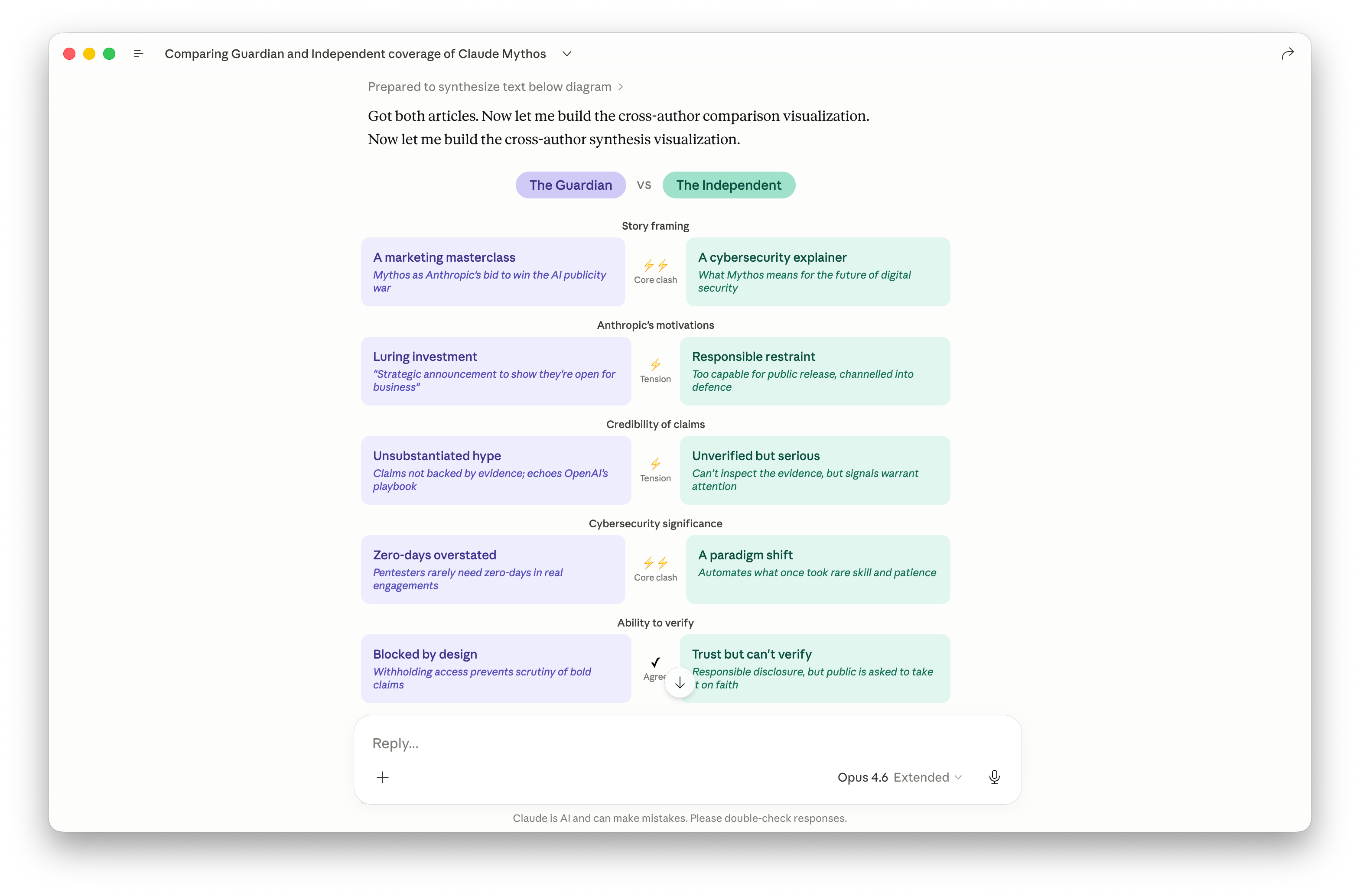
The screenshot above is a comparison skill I built, based on Mizal engine, running inside your favorite chatbot. I’ve clipped two recent articles on Anthropic’s new Mythos model in Claude (full circle). One from The Guardian, one from The Independent. Same announcement. Same underlying facts. Different angles.
The Guardian reads the restricted release as a marketing masterclass: Anthropic leveraging the narrative of danger to generate strategic positioning. The Independent reads the same announcement as a serious cybersecurity explainer.
The comparison evaluates both across five dimensions:
Story framing: is this a marketing play or a security explainer?
Anthropic’s motivations: luring investment or channelling capability into defence?
Credibility of claims: unsubstantiated hype or unverified-but-serious?
Cybersecurity significance: zero-days overstated or a genuine paradigm shift?
Ability to verify: blocked by design, or a case of trust-but-can’t-verify?
The truth likely sits between the two articles. Mythos may be a real capability leap and Anthropic is clearly leveraging the narrative for strategic positioning.
A reader with both articles open can do this work manually. Most won’t. Properly guided, a model with both articles in context can tell you where the disagreement lives, and which axes matter to a reader trying to form a view. That encoding is the editorial work.
You can spin up multiple artifacts, like this timeline:
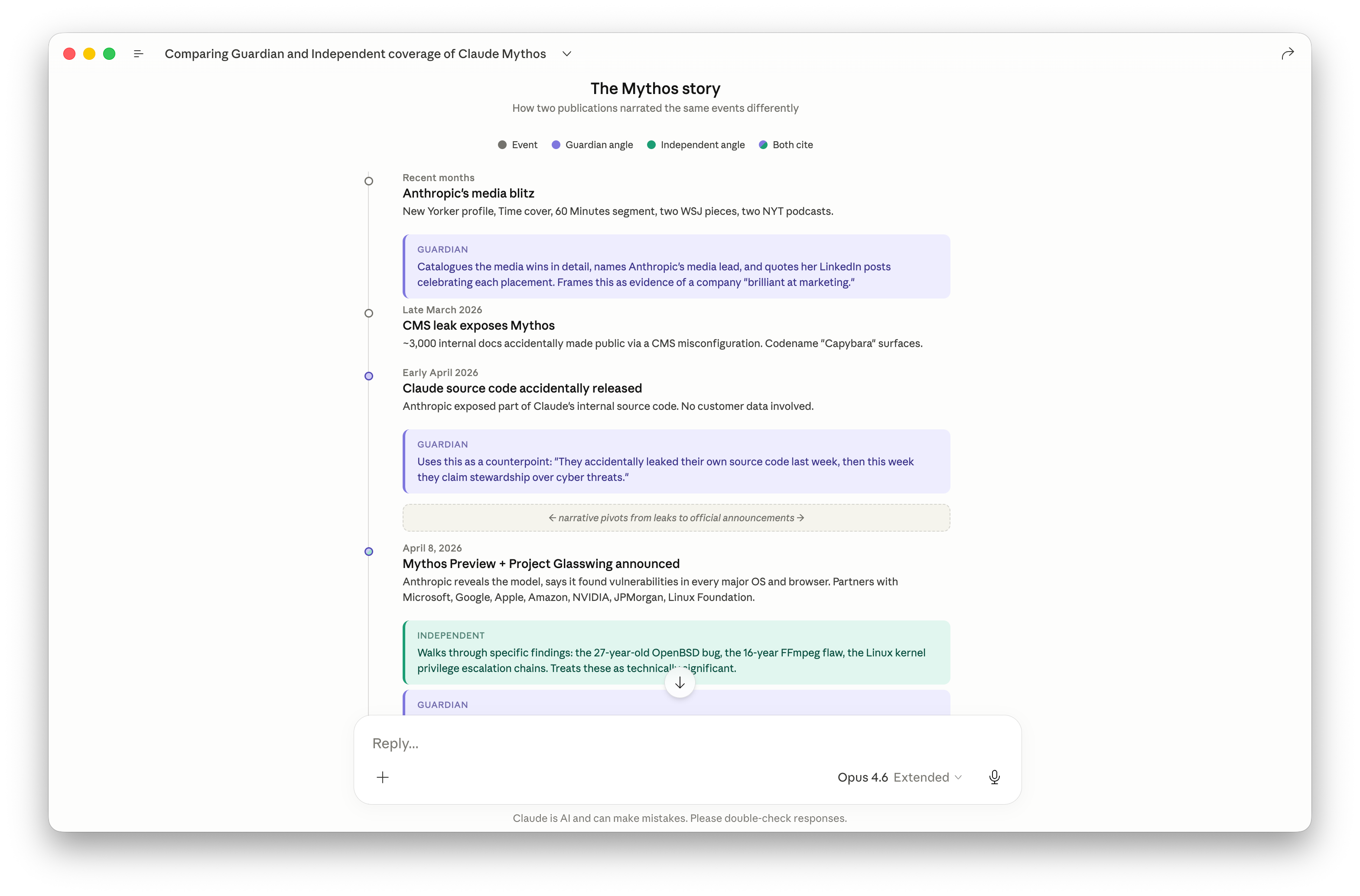
And importantly: none of it required a platform deal. Both artifacts run inside Claude because the primitives for shipping structured UI into a chatbot are open. Any newsroom could build this, today, with no permission from anyone.
From text to on-demand UI
For two years, “AI in the reading experience” meant one thing: a text answer. A paragraph. Maybe a bulleted list. The model found the information; the interface just printed it. Rendering was a default.
That’s changing.
Chatbots are now rendering components, not just text. Interactive tables. Charts that respond to the conversation. Comparison layouts. Forms that collect structured input. In the last few months, AI labs and the Model Context Protocol community have all shipped or standardized pieces of the stack that makes this possible: MCP UI resources, MCP Apps, Claude skills, ChatGPT apps, tutti quanti (sorry, I’m writing this from Perugia). Different names, same direction: the chat surface is becoming a full app container.
For a publisher, this is a double-edged thing.
The threat is obvious. If a reader can get a comparison, a dashboard, a domain assistant inside the chatbot they have fewer reasons to go to a publisher’s website to get it. The website was the main platform. It’s about to have serious competition for the job it used to do alone.
The opportunity is less obvious, but more interesting. The stack doing this is largely open source. MCP is a published protocol. MCP UI and MCP Apps have reference implementations you can read. Skills are configurable by anyone. Unlike the search era, where Google’s ranking logic was a black box, this new surface is built on primitives that any publisher can read and ship against. The building blocks are public repos, waiting to be used.
Which means: a publisher doesn’t have to wait for a platform deal to reach readers in this surface. You can build the thing directly.
That’s the approach we’re taking at Mizal. We treat skills as a product: structured, interactive experiences that live inside agent surfaces, built on open primitives, without asking anyone’s permission.
There’s also third edge: readers are starting to build for themselves. Not in the “power user writes a Python script” sense. More in the “anyone can connect their RSS feeds, bookmarks, and reading history to an AI assistant and ask it to surface patterns” sense (yeah, that’s a long sense). Personalized news digests that run on a schedule. Tools built around your own interests, not a publisher’s curation. The same open stack publishers can build against. Which could actually make things interesting, since it could make more direct relationships possible on these platforms between content producers and audience.
The form-factor battle
I want to be careful not to over-index on one comparison artifact. The point isn’t that this specific skill matters. The point is that the UI will become a battlefield. Three separate things happened this week that all pointed at the same shift:
OpenAI shipped a major update to Codex, expanding it from a coding assistant to a general-purpose workspace used by more than 3 million developers a week. Computer use, in-app browser, automations. Codex can now schedule future work for itself, wake up automatically to continue long-running tasks, and - this is the phrase I keep coming back to - proactively suggest how to start your work day. The agent surface isn’t just reactive anymore. It’s becoming a layer that decides what information you need and when.
Google shipped a Windows desktop app. Alt+Space, queries the web, local files, and installed apps, from outside the browser. Olivia Moore (a16z) put it plainly: “we are exiting the era of browsers and websites.” The company that built the browser-based distribution economy just shipped a product that bypasses it.
A very interesting called The Death of UI dropped. The line worth quoting: “Agents don’t click buttons. They prefer an API. They don’t even use SDKs. Just give me the MCP server.”
Read together: the surface is moving, the infrastructure is settling into a shape, and the capability to ship richer experiences into these surfaces is genuinely open to anyone who wants to use it.
Readers still want what a publisher’s judgment produces. They might just reach it through ChatGPT, through a desktop assistant, through a newsletter filter, through a voice agent in their car, through a dozen surfaces that aren’t your homepage or an article.
That’s a huge shift for newsrooms built on the production of artifacts like articles.
But what’s interesting is that you can explore how to encore the editorial judgment the articles would deliver, expressed directly as a product that can run inside a model, inside a desktop assistant, inside whatever comes next.
Thinking about the tech stack doesnt help people who already abandoned our content (because they don't feel represented), can't or won't interact with our products (because of price and literacy and well, being less privileged). New forms or stacks wont fix that.
I regard this piece, as interesting as it is from a technical pov, as a very, highly techno-deterministic view of what journalism/news is (for). You cannot look at technology (or form factors or services) without taking the socio-economic context of technology into account. Good journalism makes promises to people, not machines. Promises require commitment from humans, not software (as smart/intelligent as a lot of people mistake the software for these days). Anno 2026 journalism/news is perceived as 'microdosing hell' by more and more - it doesn't matter how much MCPs, new products, shapes or forms you present that content in. We've been very good at publishing more content, cheaper produced and in various new forms over the last two decades. What's been missing in the transformation is the promises that journalism is supposed to be delivering on (please read Patrick Boehler on this). It's the promises you make and keep to human audiences that matter most. No piece of software can replace that h2h-contract. AI-software might augment the process somewhere, but improving ourselves and our workflows to death, repackaging content to satisfy machine-needs... that would be the opposite and mostly wrong direction to get to a truly sustainable journalistic future and of real value to the audience we first, foremost and eventually do our work for..