

For the past few years, the dominant metaphor for AI at work has been the copilot.
Companies bought chatbot licenses for their employees (sometimes for all of them, sometimes for just a few) and prompting was an individual sport.
Then came agents. More advanced users started customizing instructions or building skills, with the most adventurous sharing them with colleagues over email - hardly the definition of convenience.
All of this lacked the most important ingredient in work: collective intelligence.
A recent wave of products suggests a different direction for AI in the workplace: it may not be about the individual chat, but the organization itself with different layers for individual, team and shared work.
AI is becoming multiplayer.
From AI seats to an agentic operating system
Take Cloudflare OS, launched last week. An organization can deploy its own version, connect it to internal systems, choose which models employees can use, and curate the knowledge, skills and policies that should guide its agents.
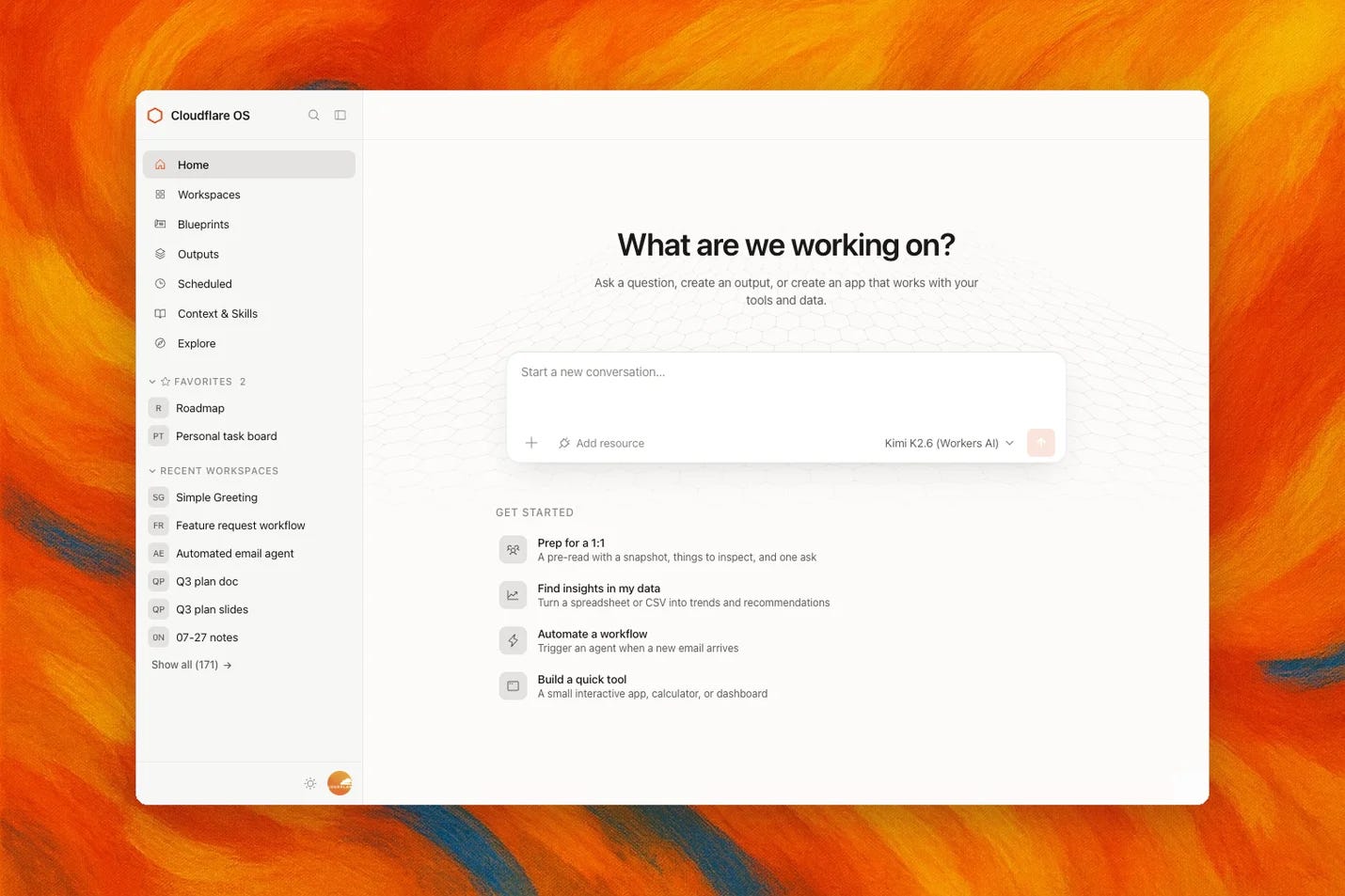
Employees work within their own persistent workspaces, granted access to company resources and an isolated environment. The organization provides the common scaffolding, while the individual has their own work environment.
This sounds like infrastructure plumbing, but it is actually the interesting part. Cloudflare also emphasizes cost controls and security, which may help avoid giving your IT colleagues a collective heart attack.
QM, released by Y Combinator, takes a slightly different approach: each person gets an isolated workspace with its own memory, files, permissions, credentials and background tasks. A Slack channel, group or project can have its own workspace too.
People can therefore work independently without mixing all their context together, then collaborate with an agent in a shared room when the work becomes collective.
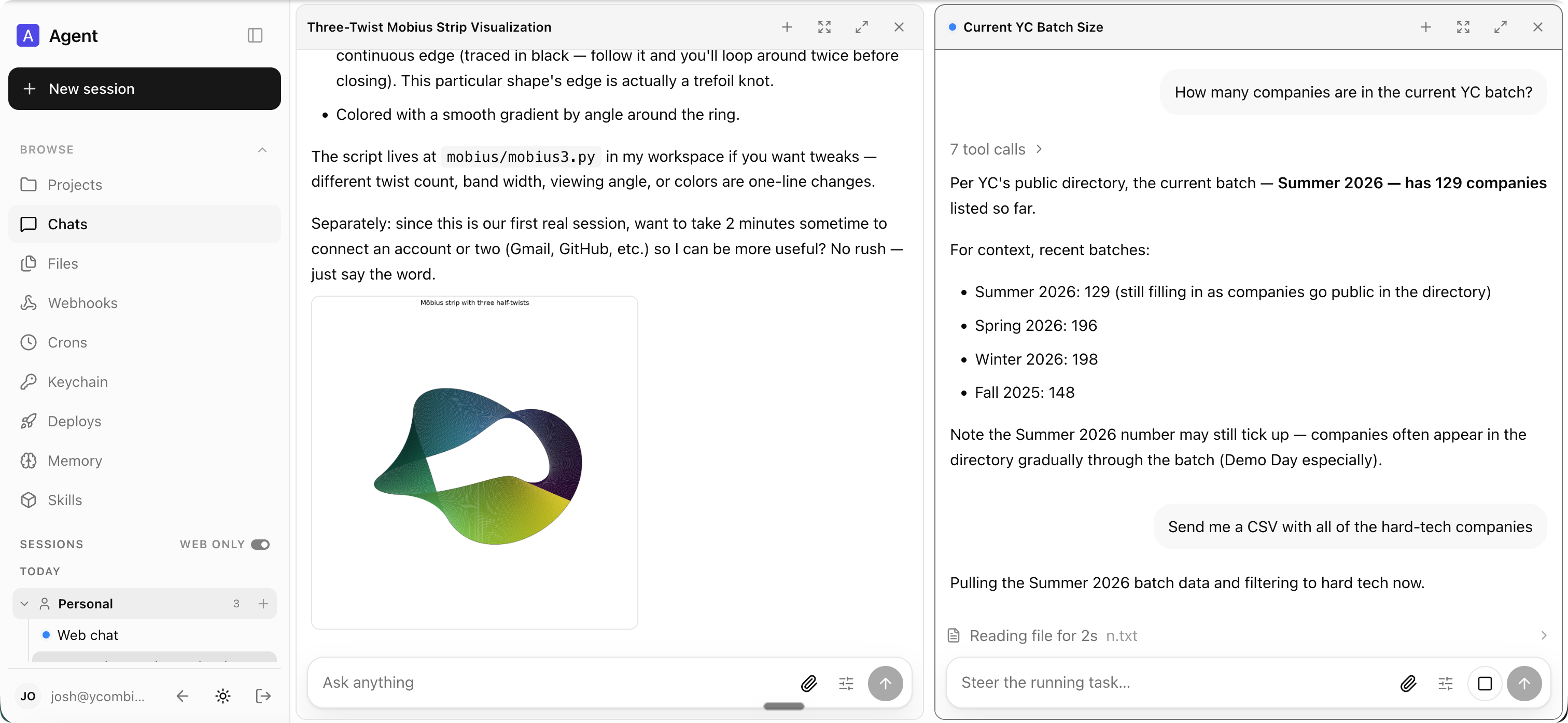
Skills built within one workspace, either individual or collective, can then be transported between them. An especially useful skill can be further cultivated, and eventually authorized as a company-wide tool by an administrator.
This is more than giving everyone access to the same chatbot. The organization deploys a common agentic foundation that individuals adapt to their work. Teams collaborate within shared projects, and useful knowledge and workflows can then circulate back through the organization.
You start to get a loop:
The organization provides context and skills > Individuals do the work > Teams collaborate around it > What they learn improves the shared system.
Then there is Ace, a research prototype from GitHub Next described as a multiplayer coding workspace. In this program, teammates and coding agents work in the same real-time session. They share a chat, a cloud computer and a live preview of what they are building. They can see the full prompting history, edit the agent’s plan together and intervene while the work is happening.
It is heavily oriented toward coding, but you can easily imagine similar environments for content production.
Anthropic and OpenAI have started exploring this shift too. OpenAI Frontier gives agents shared organizational context, permissions and feedback loops, while Claude Tag lets teams bring Claude directly into shared Slack channels. We can expect both companies to push much further into collaborative AI over the next few months.
These products are different and still early. But together they sketch an agentic operating environment with:
a common layer of knowledge, skills, tools and policies
private or scoped spaces where individuals can work
shared spaces where teams and agents collaborate
a way for useful workflows to become collective assets
Which is much more interesting than either a giant chatbot shared by the company or hundreds of disconnected personal copilots.
When people can do more, workflows have to change
Single-player AI is already changing how work moves through organizations. OpenAI recently analyzed more than 800,000 work-related ChatGPT messages and found that, among occupation-specific messages, 43.5% involved tasks associated with another occupation.
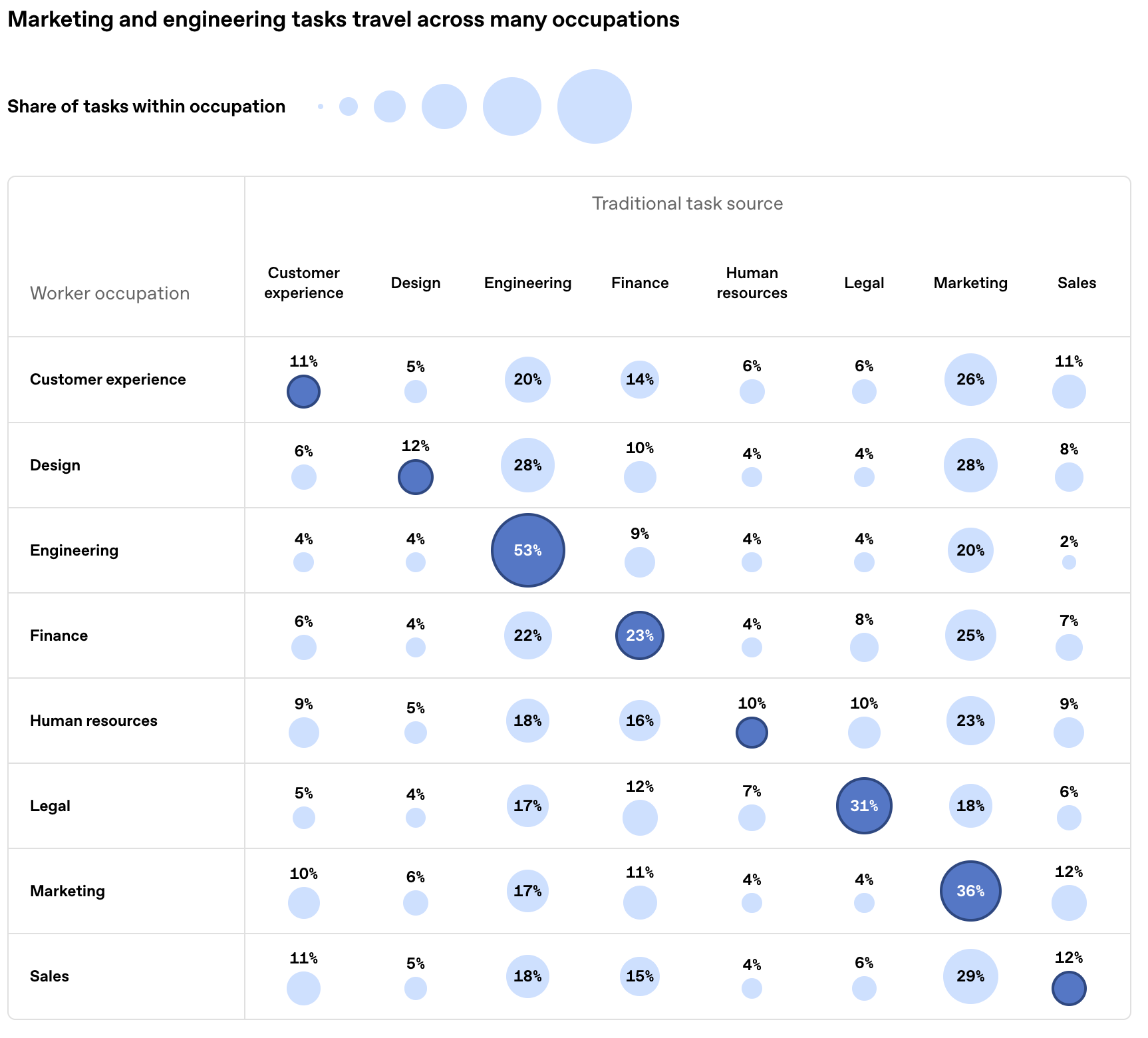
A marketer can analyze data without waiting for an analyst and a designer can troubleshoot software. OpenAI calls this “task crossover”: AI allows people to take on work that would previously have required a handoff.
That can be hugely useful. But handoffs are not always just inefficiencies waiting to be optimized away.
Take a newsroom. A reporter benefits from an editor’s challenge or a lawyer’s caution and an audience editor’s understanding of what readers need. These people bring different forms of judgment, not simply executing different tasks.
If AI helps everyone do more inside private chats, people may bypass those interactions entirely. Individual productivity can rise while collective editorial judgment becomes more fragmented.
And when everyone can produce more, alignment becomes more expensive.
What a multiplayer newsroom could look like
If AI is becoming multiplayer, this could mean a lot for newsrooms, which are essentially collaboration engines. It opens up the possibility for a shared yet private space where the interaction between human and AI is made visible.
We typically only see the final artifact: the summary, the memo, the dataset or the draft. But the final artifact tells us very little about how it was produced.
A practical trail of the work could be much more interesting, both for humans and agents. It could contain:
the questions and instructions given to the agent
the sources and organizational knowledge it used
the searches, comparisons and transformations it performed
the gaps and uncertainties it identified
the corrections and challenges introduced by humans
the final editorial decisions and the reasons behind them
This trail should be collaborative too. An editor should be able to enter the work while it is happening, see how the agent and reporter arrived at the current state, add context, question an assumption or change the plan. Google Docs, AI version.
Imagine a live agentic workspace around an election or a major investigation.
At the organizational level, the newsroom deploys shared skills covering its sourcing standards, verification practices, legal guidance, archive and recurring editorial workflows.
A reporter begins in a private scope. It contains sensitive sources, personal notes and early hypotheses that should not be visible to the entire newsroom. Shared should not mean that everyone sees everything. In journalism, that would be a pretty terrible design choice.
When the story becomes a team effort, the reporter creates a shared story workspace. The relevant documents, reporting and agent sessions move into it. Editors, specialists and agents can join, each with the permissions appropriate to their role.
The agent helps maintain a living record of what has been verified, what remains uncertain, which sources support each claim, contradictions across documents, promising leads, previous coverage and important decisions made by the team.
An editor can see that the agent flagged a claim, review the sources behind it and decide that another confirmation is required. A standards editor can explain why a particular attribution is insufficient. You get the idea.
And if those interventions reveal a reusable principle, it can become part of the newsroom’s shared skills. The next journalist does not need to repeat the same mistake for the organization to learn the same lesson again.
A newsroom that learns
In a previous piece, I argued that AI becomes genuinely useful when editorial judgment is codified, tested and kept accountable to humans.
My shorthand was: Codify the decision rights. Delegate the execution rights.
A newsroom might teach an agent what counts as a substantive policy change, when an anonymous source needs further corroboration, or what makes a development worth flagging to the desk.
But codifying judgment should not mean writing a perfect instruction manual once and handing it to a model. Much of the real judgment emerges through work.
It lives in an editor asking for a second source, a reporter explaining why a data point is misleading, or a skeptical colleague pointing out that the official account does not match what people are experiencing.
If those exchanges happen in private conversations or disappear after publication, the organization cannot learn from them.
A multiplayer environment creates another possibility. Editorial judgment can be expressed during the work, attached to the relevant evidence, tested against the outcome and, when appropriate, incorporated into a shared skill.
The loop becomes:
The newsroom teaches the agent > The agent helps an individual > The individual brings the work to the team > The team challenges it > What the team learns improves the shared system.
That is how editorial judgment could compound instead of repeatedly disappearing into people’s heads. And this is why the multiplayer turn in AI feels important.
The newsroom of the AI era should give journalists space to work independently, teams a place to think with agents together, and the organization a way to learn from both.